As the world grapples with accelerating climate change, artificial intelligence is emerging as one of the most powerful tools available for understanding, mitigating, and adapting to environmental challenges. From optimizing global energy grids to monitoring deforestation from orbit, AI systems are providing capabilities that were unimaginable just a few years ago.
AI for Climate Modeling and Prediction
Climate modeling has been transformed by AI's ability to process vast amounts of data and identify complex patterns. Traditional climate models, based on physics simulations, require enormous computational resources and can still produce significant uncertainty in regional predictions. AI-enhanced models are dramatically improving both accuracy and computational efficiency.
Google's DeepMind, in collaboration with the European Centre for Medium-Range Weather Forecasts, has developed AI weather prediction systems that can generate 10-day forecasts in under one minute on a single computer, compared to hours on a supercomputer for traditional models. GraphCast, the latest version of this system, achieves accuracy superior to the best physics-based models for 90% of weather variables. This speed enables earlier warnings for extreme weather events, giving communities more time to prepare for hurricanes, heatwaves, and floods.
Researchers at the University of Cambridge and Microsoft have demonstrated that AI-powered emulators can accelerate climate simulations by a factor of 1,000. These neural network models learn to approximate the behavior of complex physical models, enabling climate scientists to run thousands of simulations in the time it would take to run one traditional model. This capability is particularly valuable for understanding climate tipping points — thresholds beyond which climate changes become self-accelerating and potentially irreversible.
Renewable Energy Optimization
AI is playing a crucial role in integrating renewable energy sources into electrical grids. Solar and wind power are inherently variable — the sun does not always shine, and the wind does not always blow — making grid management significantly more complex than with traditional fossil fuel plants. AI systems are addressing this challenge by predicting renewable generation with remarkable accuracy and optimizing grid operations in real-time.
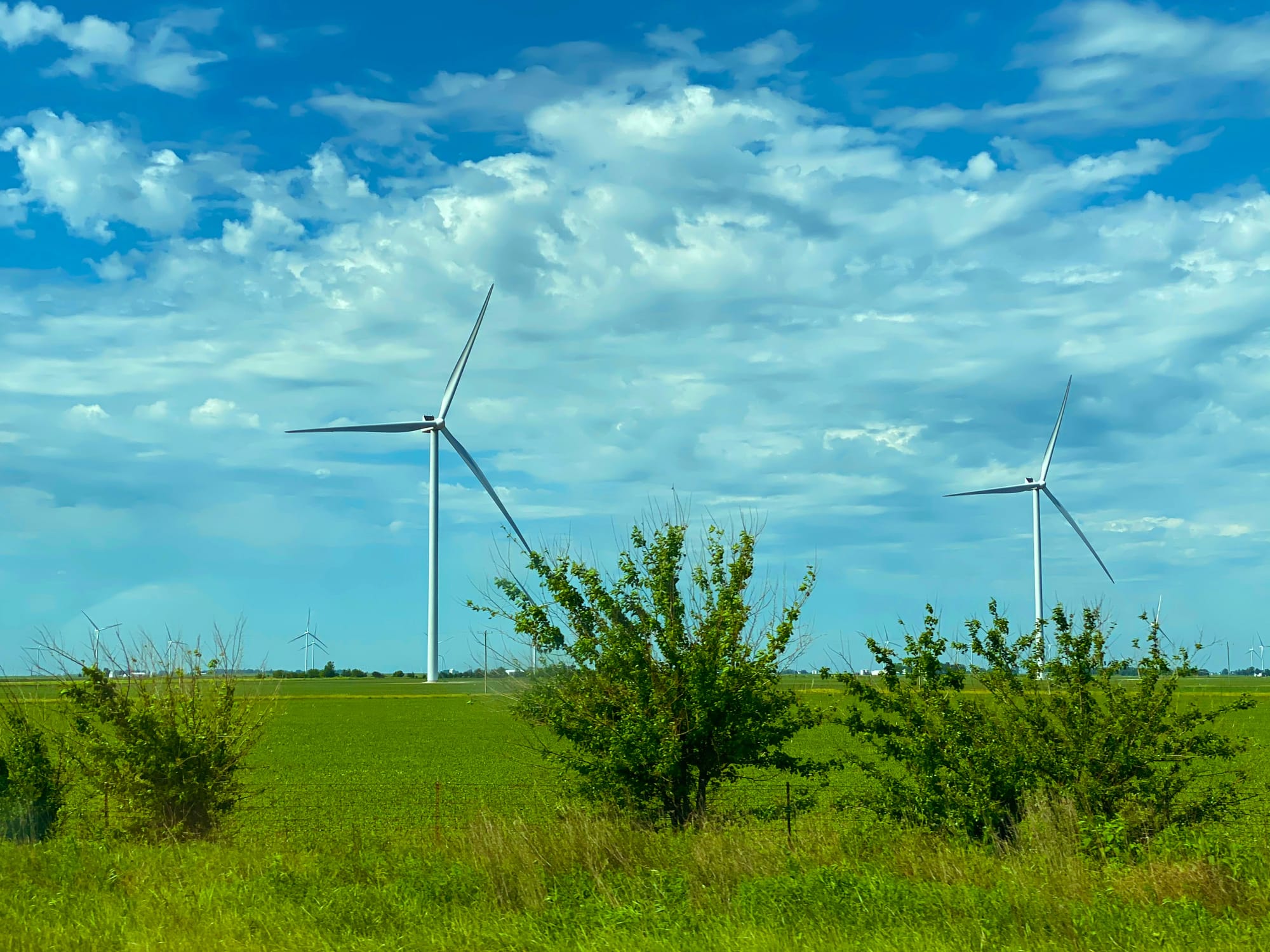
Google's DeepMind has deployed AI systems at wind farms across the United States that predict wind power output 36 hours in advance with 20% greater accuracy than traditional forecasting methods. This allows grid operators to schedule backup power more efficiently and reduce reliance on fossil fuel reserves. The company reports that AI-optimized wind farm scheduling has increased the value of wind energy by approximately 20%.
National Grid ESO in the United Kingdom uses an AI system to manage the balance between supply and demand across the country's electricity network, incorporating data from thousands of solar installations, wind farms, battery storage systems, and interconnectors to other countries. The system has enabled the UK grid to operate for over 100 consecutive days without coal power and has reduced carbon emissions from electricity generation by 15% year-over-year.
Carbon Capture and Emissions Monitoring
Accurate measurement of greenhouse gas emissions is essential for effective climate action, and AI is enabling monitoring at unprecedented scale. Satellite-based AI systems from companies like Planet Labs and GHGSat can detect methane leaks from oil and gas infrastructure anywhere in the world with high precision. These systems analyze hyperspectral imagery to identify the unique spectral signatures of different gases, enabling regulators to identify and address emission sources that would otherwise go undetected.
A recent study using AI satellite analysis found that global methane emissions from the oil and gas industry are approximately 70% higher than previously reported, highlighting both the scale of the problem and the importance of accurate measurement. Several countries, including the United States and members of the European Union, are now using AI satellite monitoring as part of their regulatory enforcement efforts.
In carbon capture technology, AI is being used to optimize the chemical processes that remove CO2 from industrial exhaust streams and from the atmosphere. Direct air capture companies like Climeworks and Carbon Engineering use AI to optimize the temperature, pressure, and chemical conditions for maximum carbon absorption while minimizing energy consumption. AI-designed materials for carbon capture, including novel metal-organic frameworks and amine-based sorbents, are being developed using machine learning to predict material properties and guide synthesis efforts.
Agriculture and Land Use
AI-powered precision agriculture is reducing the environmental impact of farming while maintaining food production. Systems from companies like John Deere and Blue River Technology use computer vision and machine learning to apply fertilizer, pesticides, and water only where and when they are needed, reducing chemical runoff into waterways and cutting agricultural water consumption by up to 30%.
Satellite-based AI monitoring systems are tracking deforestation and land use change in near-real-time. Global Forest Watch uses AI to analyze satellite imagery and detect forest clearing as it happens, sending alerts to authorities and indigenous communities. The system has detected over 100,000 deforestation events in 2026 alone, enabling faster enforcement responses in countries like Brazil, Indonesia, and the Democratic Republic of Congo.
The Energy Cost of AI
It is important to acknowledge that AI itself has a significant and growing carbon footprint. Training large AI models requires enormous amounts of electricity, and the rapid expansion of AI data centers is driving increased energy demand. A single large-scale AI training run can consume 50-100 megawatt-hours of electricity and generate carbon emissions comparable to several transatlantic flights. The International Energy Agency estimates that AI data centers could consume up to 5% of global electricity by 2028, up from approximately 1% today.
The major technology companies are acutely aware of this tension and are investing heavily in making AI more energy-efficient. New AI accelerator chips are increasingly designed with power efficiency as a primary goal. Model compression techniques like quantization, pruning, and distillation can reduce the energy required for inference by 10-100x without significant accuracy loss. Google, Microsoft, and Amazon have all committed to powering their AI operations with 100% renewable energy, though the pace of data center expansion is straining renewable energy supply in some regions.
Looking Ahead
AI is not a silver bullet for climate change, but it is an increasingly essential tool in the toolbox. The technology's ability to analyze vast amounts of data, optimize complex systems, and enable new monitoring capabilities makes it uniquely valuable for addressing environmental challenges. The challenge for the coming years will be to maximize AI's climate benefits while minimizing its own environmental footprint.